


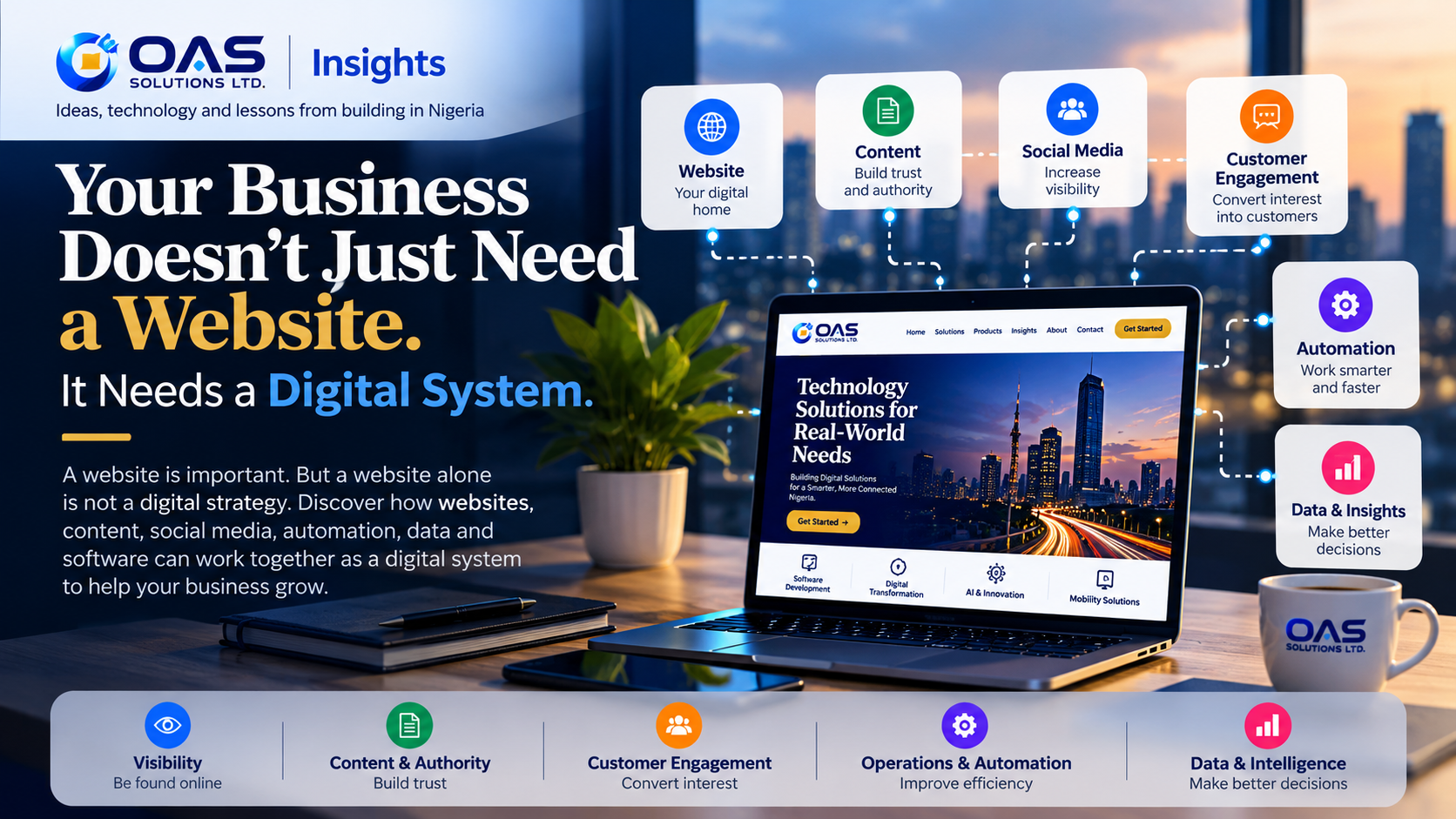
A website is important.
But a website alone is not a digital strategy.
You can have a beautiful website, an active Facebook page, a LinkedIn company profile, a WhatsApp Business account, and even a collection of digital tools—and still have a business that is not truly operating digitally.
The difference is connection.
Modern businesses need more than individual digital assets. They need those assets to work together as a system.
Your website should not exist separately from your marketing.
Your social media should not exist separately from your website.
Your customer enquiries should not disappear inside WhatsApp.
Your business data should not be scattered across spreadsheets, phones, and different applications.
And your technology should not simply look impressive. It should help the business operate better, understand its customers, make better decisions, and grow.
This is where digital transformation begins.
From Digital Presence to Digital System
For years, the first question businesses asked was:
“Do we have a website?”
That was a reasonable question.
Today, the better question is
“How does our digital presence work together to support the business?”
Imagine a potential customer discovers your company through a Google search.
They visit your website.
They read one of your articles.
They see your LinkedIn page.
They find a useful resource.
They contact you through WhatsApp.
Their enquiry is recorded.
Someone on your team follows up.
The customer eventually becomes a client.
The transaction enters your business system.
You can later see where the customer came from, what they purchased, how much they spent and whether they return.
That is more than having a website.
That is a digital system.
The Five Layers of a Business Digital System
A useful way to think about digital transformation is to break the system into several connected layers.
1. Visibility
The first challenge is being found.
Your potential customers need to discover that you exist.
This includes:
- Your website
- Google Search
- Google Business Profile
- Social media
- Online directories
- Search-engine optimisation
- Digital advertising
- Content marketing
A business that cannot be found online has already lost part of the customer journey.
But visibility is only the beginning.
Our previous OAS Insights article examined why many Nigerian businesses have websites but remain difficult to find online. The problem is often not the absence of a website but the absence of the wider system around it.
2. Content and Authority
Once people discover your business, the next question is:
Why should they trust you?
This is where content becomes powerful.
Your blog can answer customer questions.
Your LinkedIn page can demonstrate expertise.
Your Facebook page can build community.
Your videos can explain difficult ideas.
Your case studies can demonstrate results.
Your newsletters can maintain relationships.
Your educational resources can help potential customers make better decisions.
This is why we believe a business blog should not be treated as an abandoned page where articles are published occasionally.
A good knowledge platform can become an engine that feeds the entire content ecosystem.
One strong article can become:
- A LinkedIn post
- A Facebook post
- A carousel
- A short video
- Several quotations
- An email
- A discussion topic
- A customer FAQ
- A future article
The content becomes an asset rather than a one-time publication.
3. Customer Engagement
Visibility and content bring people into your ecosystem.
But what happens next?
This is where many businesses lose potential customers.
Someone sends a message.
Nobody responds quickly.
Someone asks for information.
The response is buried in a WhatsApp conversation.
A potential customer fills out a form.
Nobody follows up.
A customer asks the same question repeatedly because there is no knowledge base or automated process.
Digital transformation should reduce this friction.
Depending on the business, this could involve:
- Contact forms
- WhatsApp integration
- Customer relationship management systems
- Automated email
- Appointment scheduling
- Customer portals
- Chatbots
- Notifications
- Lead tracking
- Online payments
The objective is not to automate everything simply because technology makes automation possible.
The objective is to make the customer journey easier and more reliable.
4. Operations and Automation
This is where technology starts changing the business itself.
A business may begin with:
- Excel spreadsheets
- WhatsApp groups
- paper records
- manual invoices
- handwritten registers
- separate applications
- repeated data entry
There is nothing inherently wrong with starting this way.
In fact, these tools can be perfectly appropriate when a business is small.
The problem comes when the business grows but the systems remain the same.
Orders increase.
Customers increase.
Employees increase.
Transactions increase.
Data increases.
But the process remains manual.
Eventually, the business starts spending more time managing information than serving customers.
That is often the point at which software, automation and integrated systems begin to create significant value.
As we explored in our earlier article on custom software, businesses often reach a point where disconnected tools, repetitive manual work and unreliable reporting begin to constrain growth.
The solution is not always custom software.
Sometimes the answer is a better configuration of existing tools.
Sometimes it is automation.
Sometimes it is a simple internal dashboard.
Sometimes it is a properly designed management system.
And sometimes a custom application really is the right answer.
The important thing is to solve the business problem first and choose the technology second.
5. Data and Intelligence
There is another layer that businesses increasingly cannot afford to ignore:
Data.
Every interaction can potentially produce useful information.
A customer enquiry.
A website visit.
A completed order.
A payment.
A support request.
A marketing campaign.
A product review.
A cancelled transaction.
A repeat purchase.
If this information is captured properly, it can help answer important questions:
- Which products are performing best?
- Where are customers coming from?
- Which marketing channels generate leads?
- Which customers return?
- Where are operational bottlenecks?
- Which services generate the most revenue?
- How long does it take to serve a customer?
- Where are we losing potential customers?
This is where digital transformation begins to move beyond digitisation.
You are no longer simply using technology to perform the same activities.
You are using technology to understand the business better.
And increasingly, artificial intelligence can sit on top of these systems to help businesses analyse information, automate processes and support decision-making.
The Website Is Still Important — But It Is Only One Part
None of this means that websites are becoming irrelevant.
Quite the opposite.
Your website can become the central hub connecting many parts of your digital ecosystem.
It can:
- Explain what your business does
- Build credibility
- Publish your knowledge
- Generate leads
- Showcase products
- Receive enquiries
- Accept bookings
- Process payments
- Provide customer support
- Connect to other systems
- Capture useful data
The problem is when the website is treated as the destination rather than part of the system.
A business spends money creating a website.
The website launches.
Everyone celebrates.
Then nothing happens.
No new content.
No SEO.
No measurement.
No conversion strategy.
No integration.
No maintenance.
No improvement.
Six months later, the website is still there — but it is doing very little.
A digital system is different.
It is designed to evolve.
Digital Transformation Is Not Just for Big Companies
One misconception we encounter frequently is that digital transformation is something reserved for banks, telecom companies and large corporations.
It isn't.
A small school can digitise admissions, fee management and communication.
A logistics company can digitise dispatch and tracking.
A hospital can digitise records and appointments.
A retailer can integrate inventory, orders and customer information.
A professional service firm can automate enquiries, appointments and follow-up.
A cooperative can digitise member contributions and statements.
A startup can build a platform that solves a problem traditional businesses have struggled with for years.
The technology may be different.
The principle is the same:
Use technology to make the organisation more visible, more connected, more efficient and more intelligent.
Start With the Problem, Not the Technology
This is perhaps the most important principle.
Digital transformation should not begin with:
“Which software should we buy?”
It should begin with:
“What problem are we trying to solve?”
For example:
Problem: Customers cannot easily find us.
Possible response:
SEO + content + website optimisation + local search.
Problem: Staff spend hours entering the same information.
Possible response:
Automation or custom software.
Problem: Customer enquiries are being lost.
Possible response:
CRM + lead tracking + notifications.
Problem: Management cannot see what is happening across the business.
Possible response:
Centralised data + dashboard + reporting.
Problem: Customers need to interact with us outside normal working hours.
Possible response:
Self-service portal + automation + carefully designed AI assistance.
The technology should serve the business objective.
Not the other way around.
What We Are Building at OAS
This way of thinking is also shaping the direction of OAS Solutions Ltd.
We are interested in more than building websites or applications in isolation.
We are interested in building useful digital solutions for real-world problems.
That includes software and web development, digital transformation, AI, business systems, mobility and applied technology.
Our own work has taught us that building technology is only one part of the journey.
The harder and more valuable questions are often:
What problem are we solving?
Who experiences the problem?
What does the existing process look like?
Where does technology genuinely create value?
How can the solution grow?
How do we measure whether it is working?
These questions influence how we approach our own products and projects.
Our mobility initiative, OkRide, for example, is not simply a mobile application. It involves passengers, riders, verification, payments, maps, operations, safety, data and a technology platform working together.
That is the difference between building an app and building a digital solution.
The Future Belongs to Connected Businesses
The businesses that thrive in an increasingly digital economy will not necessarily be those with the most technology.
They will be the ones that know how to connect technology to their real business objectives.
They will build systems in which:
Content creates visibility.
Visibility creates interest.
Interest creates enquiries.
Enquiries enter a structured customer journey.
Operations are supported by software and automation.
Data informs decisions.
AI increasingly helps people understand and act on that data.
And the entire system improves over time.
That is digital transformation in practical terms.
Not technology for technology's sake.
Technology that works.
Where Should Your Business Start?
If your business currently feels digitally disconnected, don't try to rebuild everything at once.
Start with an honest assessment.
Ask:
- Can potential customers easily find us online?
- Does our website clearly communicate what we do?
- Are we consistently creating useful content?
- Do our social channels support our business objectives?
- Can we track enquiries from first contact to customer?
- How much of our daily work is still unnecessarily manual?
- Where is our important business data stored?
- Can management easily see the numbers that matter?
- Which processes are slowing down growth?
- What could technology realistically improve?
You may discover that you don't need a complicated new platform.
You may simply need to connect the systems you already have.
Or you may discover that your business has genuinely outgrown its current tools.
Either way, the starting point is the same:
Understand the business first. Then design the technology around it.
Final Thoughts
A website is no longer the definition of a company's digital presence.
It is one component of a much larger ecosystem.
The real opportunity is to build a digital system in which your website, content, social media, customer engagement, software, automation, data and emerging AI capabilities work together to support the business.
That is the direction we believe technology should take.
Not simply making businesses look digital.
Making businesses work better.
At OAS Solutions Ltd, we are building and exploring digital solutions around this principle — from websites and software to business systems, AI, mobility and technology-driven innovation.
And through OAS Insights, we will continue documenting what we learn along the way.
Because some of the most useful technology lessons are not found in theory.
They are learned by building, testing, solving and improving in the real world.
OAS Solutions Ltd — Building digital solutions that transform businesses.
Join the conversation
Share your thoughts, questions or experience.